When he moves, he is like thunder and lightning; when he strikes, like wind and rain.
From a memorial stone at Tōgyō-an in Shimonoseki (erected 1911), with an inscription composed by Itō Hirobumi
HAGI
萩
1839
1839
Born in Hagi
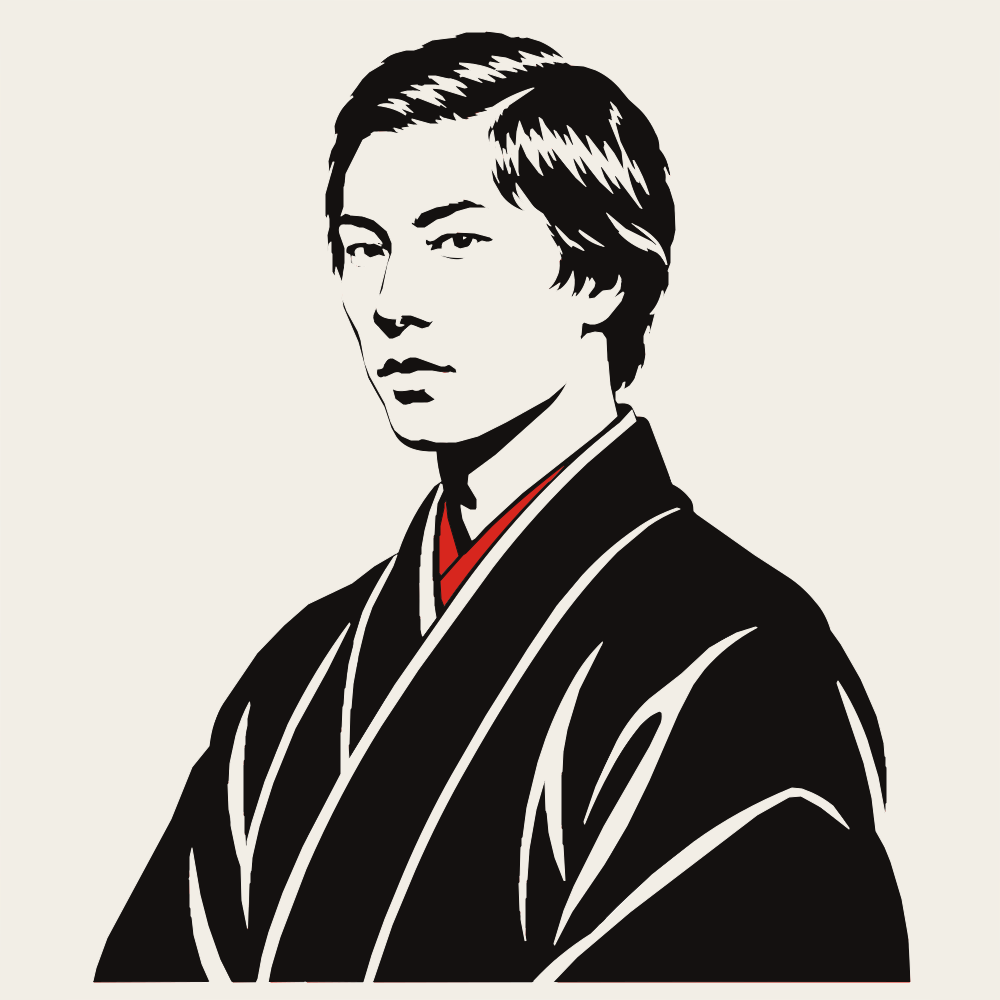
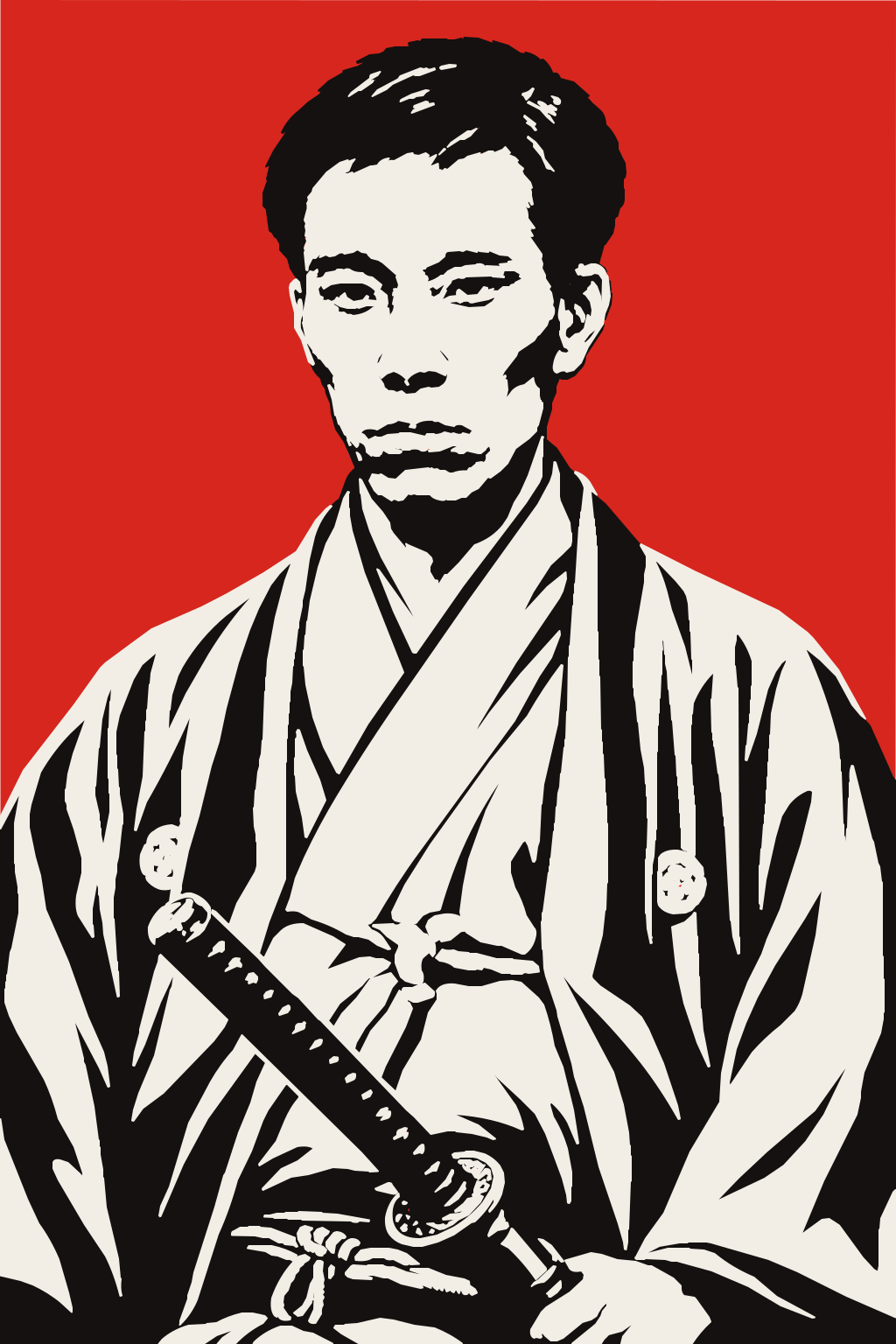
In 1839, in the castle town of Hagi in Chōshū, a boy was born who would later shake the final years of the shogunate.
Takasugi Shinsaku (Takasugi is the family name; in Japan the family name comes first) was born in 1839 in Hagi, the castle town of the Chōshū domain. A domain (han) was a feudal territory and its government, ruled by a lord (daimyō); Chōshū is in today's Yamaguchi Prefecture. Shinsaku was the eldest son of a samurai family. Japan was then governed by the Tokugawa shogunate (the bakufu), and a boy born into a samurai family was expected to inherit the family post and serve his domain.
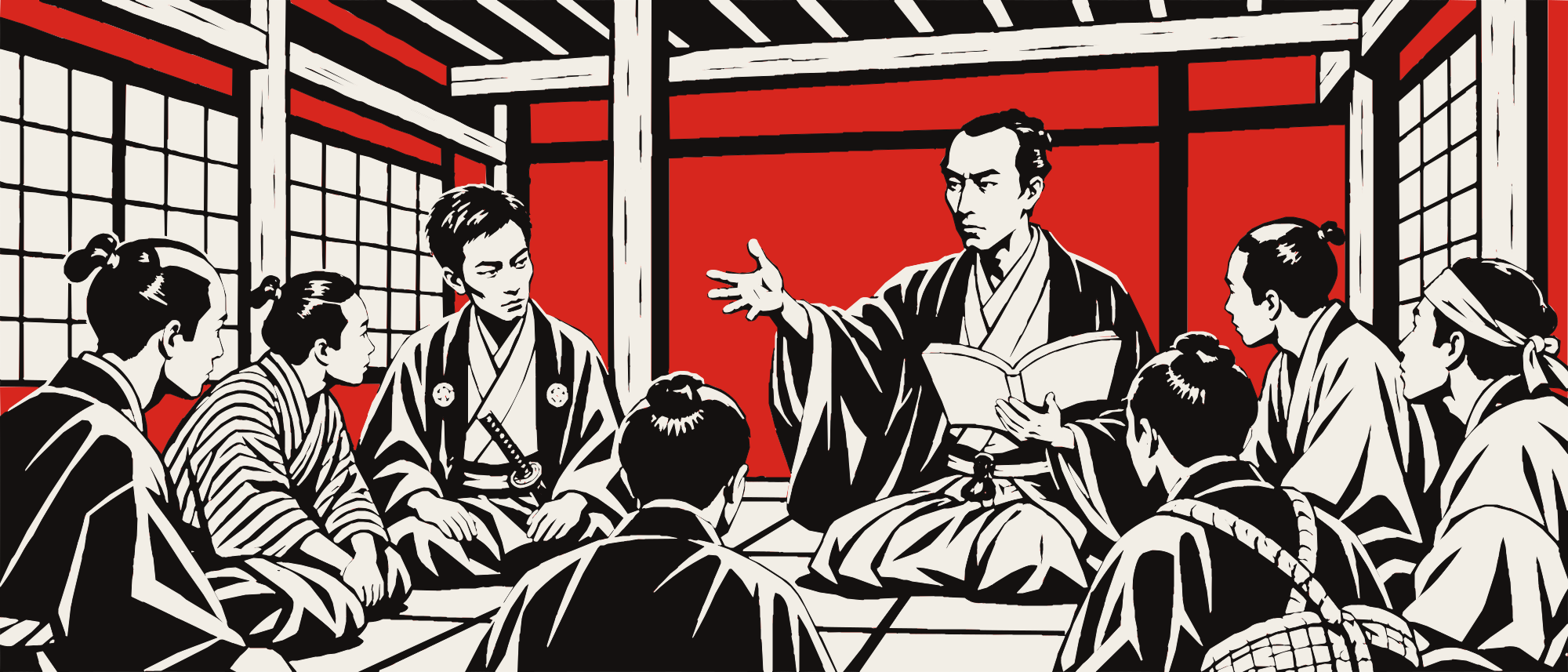
In his late teens, Shinsaku studied at the Shōka Sonjuku, a private academy run by Yoshida Shōin. Shōin was a teacher who talked with people about the country's future regardless of their rank or background. It is said that Shinsaku learned there to look at the world with his own eyes and think for himself.
But in 1859 Shōin was executed in the shogunate's harsh crackdown known as the Ansei Purge. Having lost the teacher he admired, Shinsaku set out on a restless life.
SHANGHAI
異
1862
1862
What He Saw in Shanghai
In 1862 he crossed the sea on his domain's orders and was deeply shaken by the sight of Qing China under foreign control.
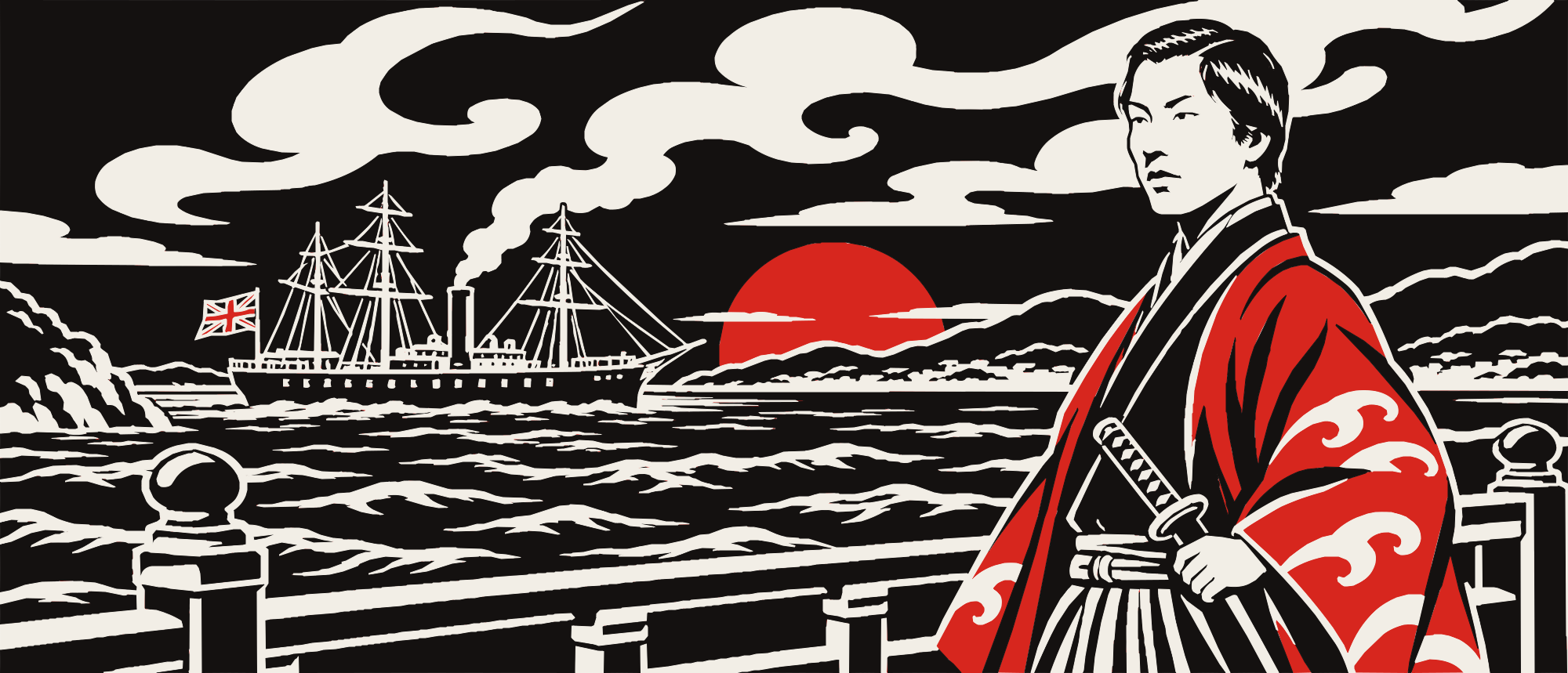
In 1862, at the age of 22, Shinsaku was chosen by Chōshū to board the Senzaimaru, a ship the shogunate sent to Shanghai to look into trade. It left Nagasaki for Shanghai, then one of Asia's great trading ports, in Qing-dynasty China. He stayed about two months.
In Shanghai, though it was a Chinese city, he saw British and French people walking about as if they owned the place, while Chinese people were made to obey them. The Qing had lost wars with Western powers, and parts of its ports were held by foreigners. Shinsaku could not dismiss it as someone else's problem.
If nothing changed, Japan might meet the same fate. With that thought he returned home. His experience in Shanghai became a major starting point for what he did next.
KIHEITAI
奇
1863
1863
An Army Open to All Ranks
In 1863 Shinsaku founded the Kiheitai ("irregular militia"), which anyone with the will could join, not only samurai.
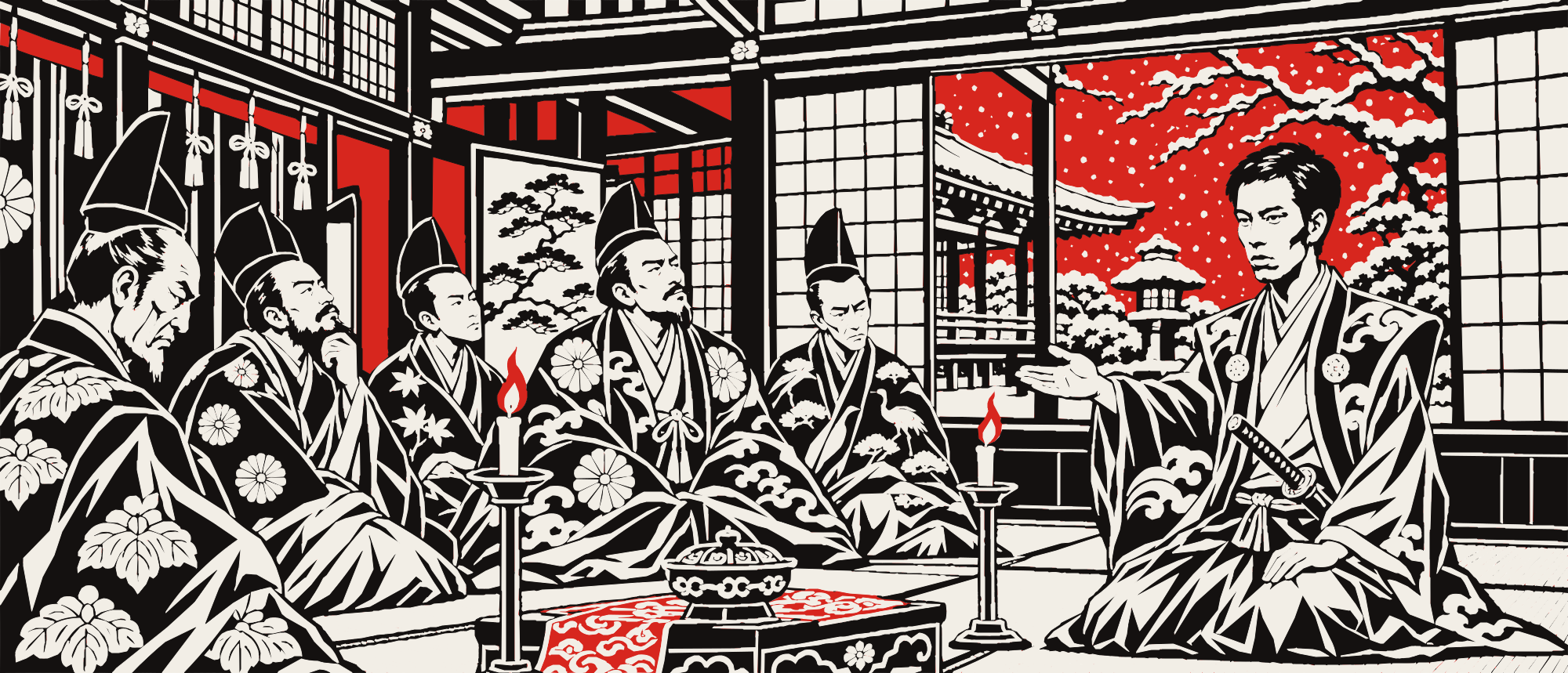
At that time the Chōshū domain held to "jōi" (the idea of driving foreign powers away) and was firing on foreign ships passing through the Kanmon Strait. But when foreign warships fired back, the domain's samurai forces were quickly overwhelmed.
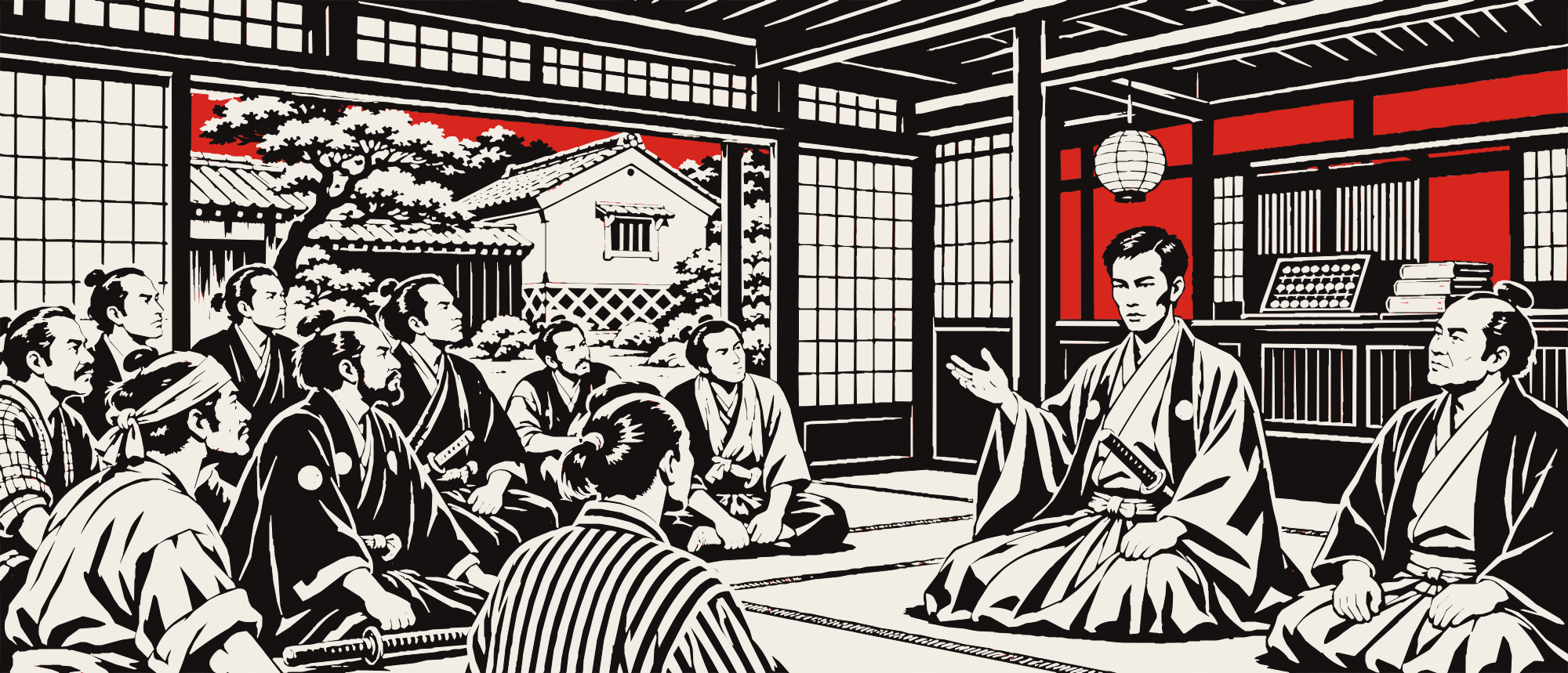
So in 1863, in Shimonoseki, Shinsaku set up a new force, the Kiheitai. It welcomed not only samurai but also farmers and townspeople: anyone with determination, whatever their rank. Fighting was then considered the job of the samurai alone, so this was a bold challenge.
The founding of the Kiheitai (1863, Shimonoseki). The house of Shiraishi Shōichirō is said to have served as its base.
Gather people by motivation and ability, not by status. This idea later spread to other units in Chōshū and changed the way the domain's army was organized.
In 1863 Shinsaku is said to have shaved his head and taken the name Tōgyō.
Flight and hidingJanuary 1864
To Kyoto Without Permission
January 1864, the year after he founded the Kiheitai. Driven out of Kyoto, Chōshū was gripped by calls to march on the capital and win back its place (the "shinpatsu" push). At their head stood Kijima Matabei.
Shinsaku thought an attack would be premature. On the orders of the domain's heir he went to talk Kijima out of it, but Kijima would not listen. Shinsaku then left the domain without permission (dappan) and headed for Kyoto, reportedly to consult Katsura Kogorō and Kusaka Genzui, who were there.
Leaving one's domain without leave was a serious offense. In February Shinsaku was persuaded by Katsura Kogorō (later Kido Takayoshi) to return to Hagi. For this offense, prison was waiting.
SHIMONOSEKI
談
1864
1864
Talks After a Defeat
In 1864, freed from prison and house confinement, Shinsaku went straight to the peace talks as the representative of a Chōshū beaten by foreign fleets.
ConfinementMarch 29 to June 21, 1864
Into Noyama Prison
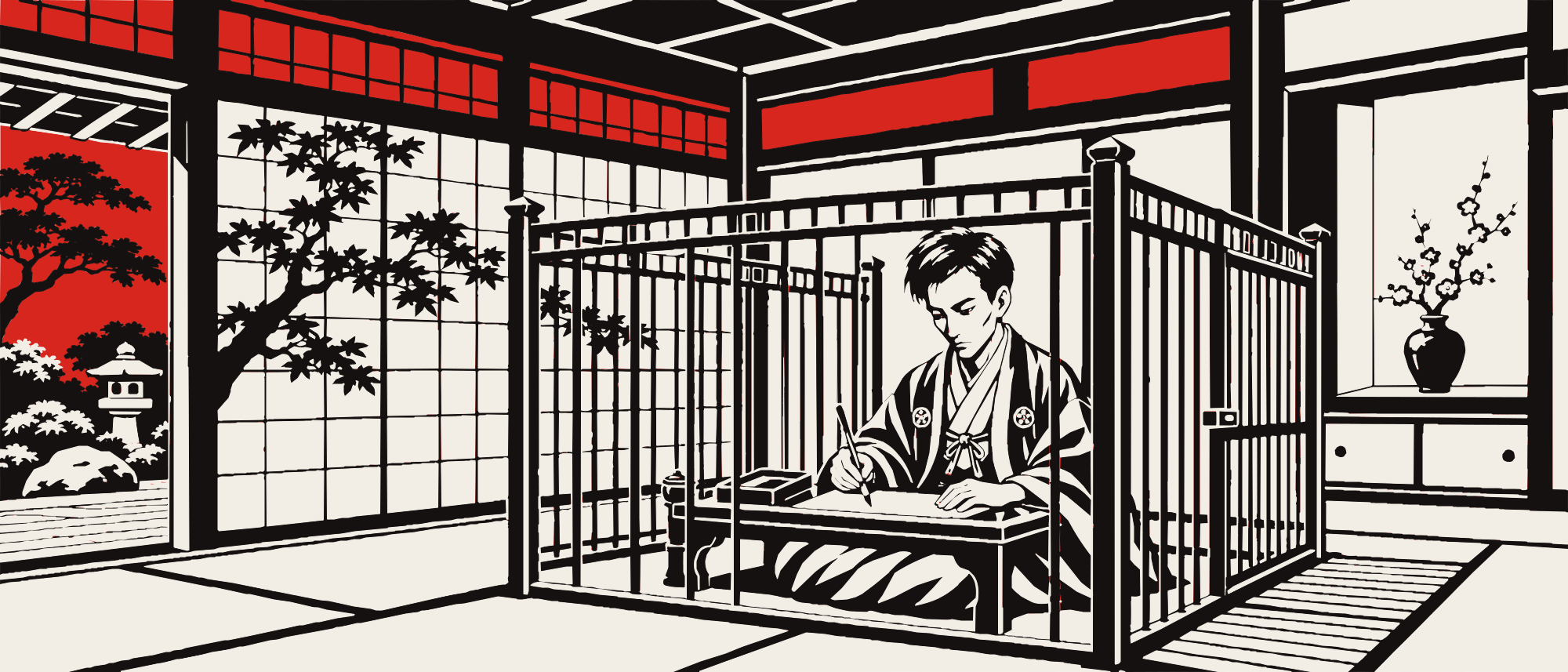
Charged with leaving his domain, Shinsaku was put into the Noyama Prison in Hagi on March 29, 1864. It was the same prison that his teacher Yoshida Shōin had once been held in.
In prison Shinsaku kept writing a diary, a prison diary (Japanese title: 投獄文記). His days were spent reading and composing poems. On some days, it is said, he read as many as 90 leaves of a Japanese bound book (about 180 pages) — a considerable amount, given that most of these books were in classical Chinese. After about three months he was released on June 21, through his father's efforts.
ConfinementJune 21 to August 1864
House Arrest in a Room Inside His Home
Leaving Noyama Prison did not make Shinsaku free. He was placed in a zashikirō (a confinement room built inside a house) at his home in Hagi, and had to stay indoors. His prison diary ends at the day of his release from the prison (June 21), and is closed by an afterword dated August 3.
In August Shinsaku was pardoned. It was just when the Four-Nation Fleet was attacking Shimonoseki, and as soon as he was pardoned he was given the task of negotiating peace.
In August 1864 the fleets of four nations (Britain, France, the Netherlands and the United States) attacked Shimonoseki in retaliation for the previous year's shelling (the Shimonoseki bombardment by the Four-Nation Fleet). Chōshū's batteries were quickly seized, and Chōshū was thoroughly defeated.
Shinsaku was chosen as the envoy for peace. It is said that he went to the talks under a different name, "Shishido Gyōma." Itō Hirobumi, who would later become Japan's first prime minister (then known as Itō Shunsuke), helped broker the peace and attended the talks. The agreement centered on guaranteeing safe passage of ships through the strait, among other terms.
The young Itō Shunsuke (later Itō Hirobumi), who was present at the peace talks, with a foreign warship behind him.
A famous legend is told about these talks. When the allied side asked to lease Hikoshima, an island of Shimonoseki at the western entrance of the Kanmon Strait, Shinsaku is said to have begun reciting the Kojiki, Japan's book of myths: from the beginning of heaven and earth, to the birth of the islands, to the Heavenly Rock Cave. The story went on and on. The land was born of the gods, he seemed to say, and is not something a person can lease. The other side was left bewildered, and the matter of Hikoshima faded away.
Ernest Satow, a British interpreter, wrote of a Chōshū envoy who boarded the British flagship under the name Shishido Gyōma (an alias attributed to Shinsaku). Satow describes the envoy as "as proud as Lucifer when he stepped on board" (Ernest Satow, A Diplomat in Japan), but says he gradually toned down and agreed to every proposal.
On the sources: the Hikoshima story rests on a later recollection by Itō Hirobumi, who helped broker the peace and attended the talks (in works such as Tōkō Yoei). The scene of reciting the Kojiki is a legend spread through novels and similar works. Neither appears in the peace documents or in British records such as Satow's memoir, so please read them as legend.
Flight and hidingAutumn and winter of 1864
To Kyushu
Even after concluding the peace, Shinsaku was not safe. As the mainstream faction of the domain leaned toward obeying the shogunate and conflict within Chōshū grew fierce, he left Shimonoseki and fled to Fukuoka in Kyushu in autumn and winter.
He took refuge at the Hirao mountain villa of Nomura Motoni, a poet. She sheltered him. Unlike being locked up in prison, these were days of going into hiding on his own, a fugitive life in concealment.
KOZANJI
起
1864
One man stands in the snow.
One voice, and one answers.
Then another. And another.
Then about eighty.
1864
Kōzanji: A Rising of Eighty Men
In December 1864 Shinsaku stood against the domain's mainstream faction with only about eighty men.
EpisodeAutumn to December 1864 (old calendar)
A Conservative Government and the Purge of the Righteous Faction
After the defeat at the Kinmon Incident, a conservative faction that urged obedience to the shogunate took power in Chōshū. (Shinsaku's side called them the "zokuron-ha", the "vulgar opinion" faction. That name came from his side, and some see it differently: the conservatives had their own reasons.) The senior retainers of the "righteous" faction, who had once led the domain, were ordered to commit seppuku, and the men known as its staff officers were executed.
The Shotai (the units, such as the Kiheitai) had rebelled against the government's order to disband, and had moved to Chōfu to protect the five court nobles led by Sanjō Sanetomi (the Gokyō). Shinsaku, who had been in Fukuoka, learned of the executions and returned to Shimonoseki in December. He urged the unit leaders to rise, but they saw little chance of winning, and he found no one to join him.
That summer Chōshū had lost a battle in Kyoto (the Kinmon Incident), and then lost to the Four-Nation Fleet. It was also about to be attacked by a large shogunate army (the First Chōshū Expedition). The domain's mainstream faction chose to submit to the shogunate without resistance, and began to press hard those who, like Shinsaku, urged resistance.
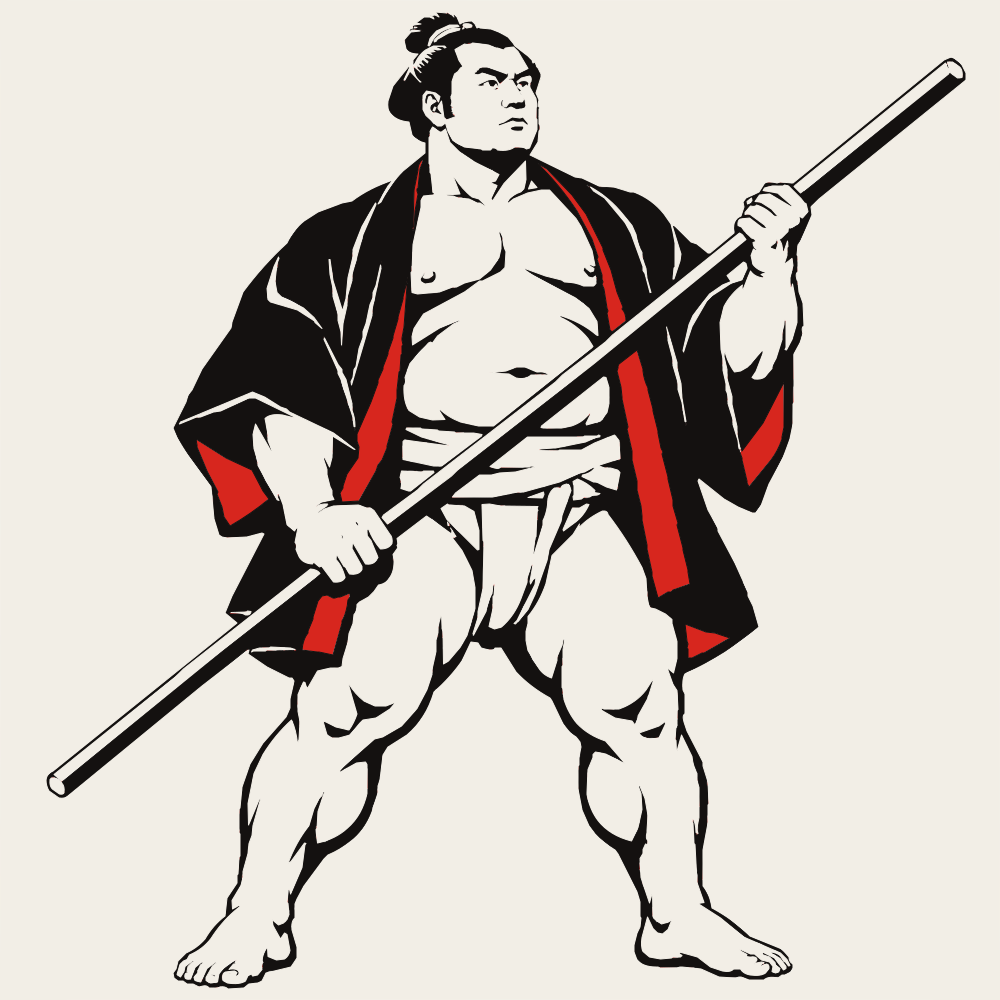
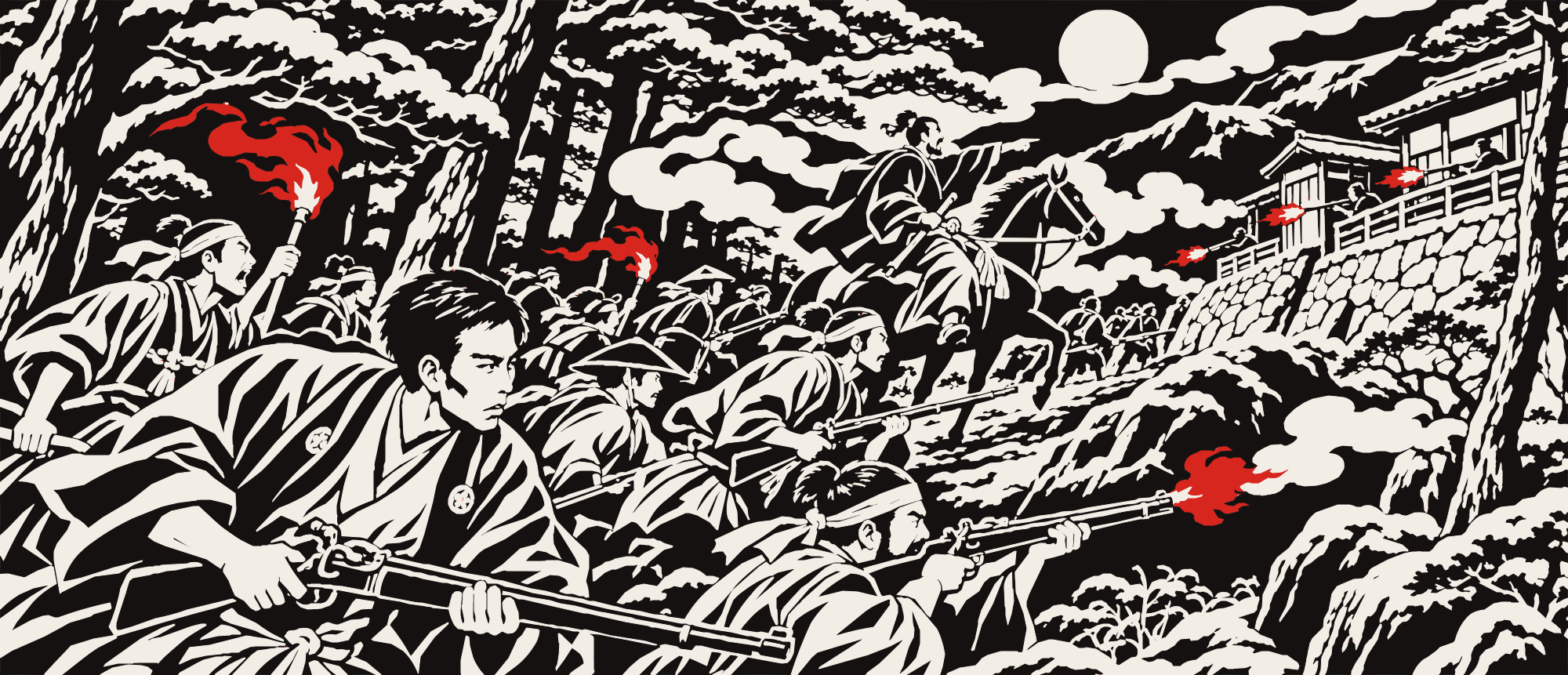
On the 15th day of the 12th month of 1864 (by the old calendar), with snow in the air, Shinsaku raised troops at Kōzanji Temple in Chōfu (now part of Shimonoseki) together with about eighty men, including Itō Hirobumi and the Rikishitai (a unit of sumo wrestlers) and the Yūgekitai (a ranger unit). By numbers, they were no match for the domain's mainstream. Moreover, the other units had not yet moved.
Itō Shunsuke (later Itō Hirobumi), who led the Rikishitai.
Shinsaku and his men first seized the domain's office in Shimonoseki. In time the Kiheitai and other units joined, and in early 1865 they took back control of the domain. Even in Shinsaku's short life, it was his boldest move.
EpisodeNight of the 15th day of the 12th month, 1864 (old calendar; 12 January 1865 in the new calendar; some sources say the early hours of the 16th)
Farewell to the Five Nobles, and a Rising in the Snow
Kōzanji was the temple where the Gokyō were staying. Shinsaku announced his decision to rise there. It is explained that he meant to make the act look like one with a just cause, not a private revolt. Some sources say the nobles handed him a banner inscribed with the words "loyalty penetrates to the marrow". The Chōfu domain had asked him beforehand to reconsider, but it is said they did not block his way.
About eighty men set out (some sources say eighty-four): roughly thirty in the Rikishitai led by Itō Hirobumi (then called Shunsuke), fifty to sixty in the Yūgekitai under Ishikawa Kogorō, and Maehara Issei and others. The leaders of the Kiheitai and the other units judged the cause hopeless and premature, and did not move at that time. It is said that Shinsaku set out declaring that he would show the "guts" (or "skill") of a man of Chōshū. The wording differs from source to source and has not been confirmed in a primary source, so it is safest to treat it as tradition.
EpisodeNight of the 15th to the 16th day of the 12th month, 1864 (old calendar; 12 to 13 January 1865)
Seizing the Shinchi Kaisho in Shimonoseki
Leaving Kōzanji, Shinsaku and his men attacked and took the Shinchi Kaisho, the domain's local office in Shimonoseki. The aim was to secure weapons, ammunition and supplies. Some sources say it was taken without any real fighting.
Where the money came from differs by source. One account says the funds and rice had been moved elsewhere beforehand, and that what the office handed over could not cover the costs of some eighty men. Another says supplies were gathered through donations from supporters. It cannot be settled.
EpisodeDecember 1864 (old calendar; the exact date differs by source)
Taking Warships at the Naval Office in Mitajiri
Shinsaku is said to have taken a band of a dozen or so resolute men (sources say 18 or 20) by sea from Shimonoseki to Mitajiri in Hōfu, some seventy kilometers away. The domain had a naval office there, and they took its warships.
The names and number of the ships differ by source. Many sources say Shinsaku himself was with the band, but the details cannot be fully confirmed.
EpisodeJanuary 1865 (old calendar; February in the new calendar)
The Units Rise: The Battles of Ōta and Edō
In January 1865 the government army pressed on the units: a vanguard of about 1,200 men at Edō and a main force of about 1,400 at Akiraki. The units were outnumbered. In the night of the 6th into the early morning of the 7th, fifty or sixty men of the units attacked the government troops at Edō by night and took the place (1 to 2 February in the new calendar). The units that had not moved at Kōzanji began to join the fighting from here.
The units gathered at Ōta, an estimated five hundred men. Around the 14th, rain made the government army's matchlocks useless. On the night of the 16th the Yūgekitai, the Kiheitai and the Hachimantai attacked the government headquarters at Akamura from three directions, and the government army fled (11 February in the new calendar). Shinsaku's Yūgekitai also reached Ōta, but what Shinsaku himself did on the battlefield is not clear from the sources.
In mid-February the units surrounded the castle town of Hagi. The conservative Mukunashi Tōta and others escaped, and men of the righteous faction held in prison, such as Odamura Iinosuke, were released. The conservative government collapsed here.
In March the domain settled on a policy called "bubi kyōjun" (build up arms while keeping peace with the shogunate); sources give the date as 17 or 23 March. It meant avoiding war with the shogunate while preparing its forces. How the lord, Mōri Takachika, came to change course is not clear in the sources. So the struggle for control of the domain, which began at Kōzanji, ended with Shinsaku's side taking it back.
Flight and hidingApril to June 1865 (old calendar)
Katsura Returns, and Shinsaku Goes to Sanuki
Katsura Kogorō (later Kido Takayoshi).
Having won, Shinsaku did not take a place at the center of the domain's politics afterward. In April he left Shimonoseki with Ōno, his companion, and fled to Sanuki on Shikoku (now Kagawa Prefecture), where he turned to Kusanagi Enseki. It is also said that men of the "jōi" (expel the foreigners) camp were after his life.
At the end of that same April, Katsura Kogorō, who had been hiding in Izushi (now in Hyōgo Prefecture), reached Shimonoseki. On 27 May he took a seat in the domain's Seimuza (policy council) and came to carry real weight in running it. In June, through Katsura's mediation, Shinsaku returned to Shimonoseki. These were not days of confinement but of exile, living under another's protection.
SHIKYO
Shogunate army
Chōshū army (counter-attack)
SHIKYO
戦
1866
1866
The Four Borders War: Pushing Back the Shogunate
In 1866, surrounded by the shogunate's huge army, Chōshū pushed back the shogunate forces at Kokura and elsewhere.
In June 1866 the shogunate sent a large army to attack Chōshū (the Second Chōshū Expedition; because Chōshū fought on four fronts along its borders, it is also called the Four Borders War, or Shikyō Sensō). There were four lines of attack: Ōshima, Geishū, Sekishū and Kokura. The shogunate forces far outnumbered Chōshū's.
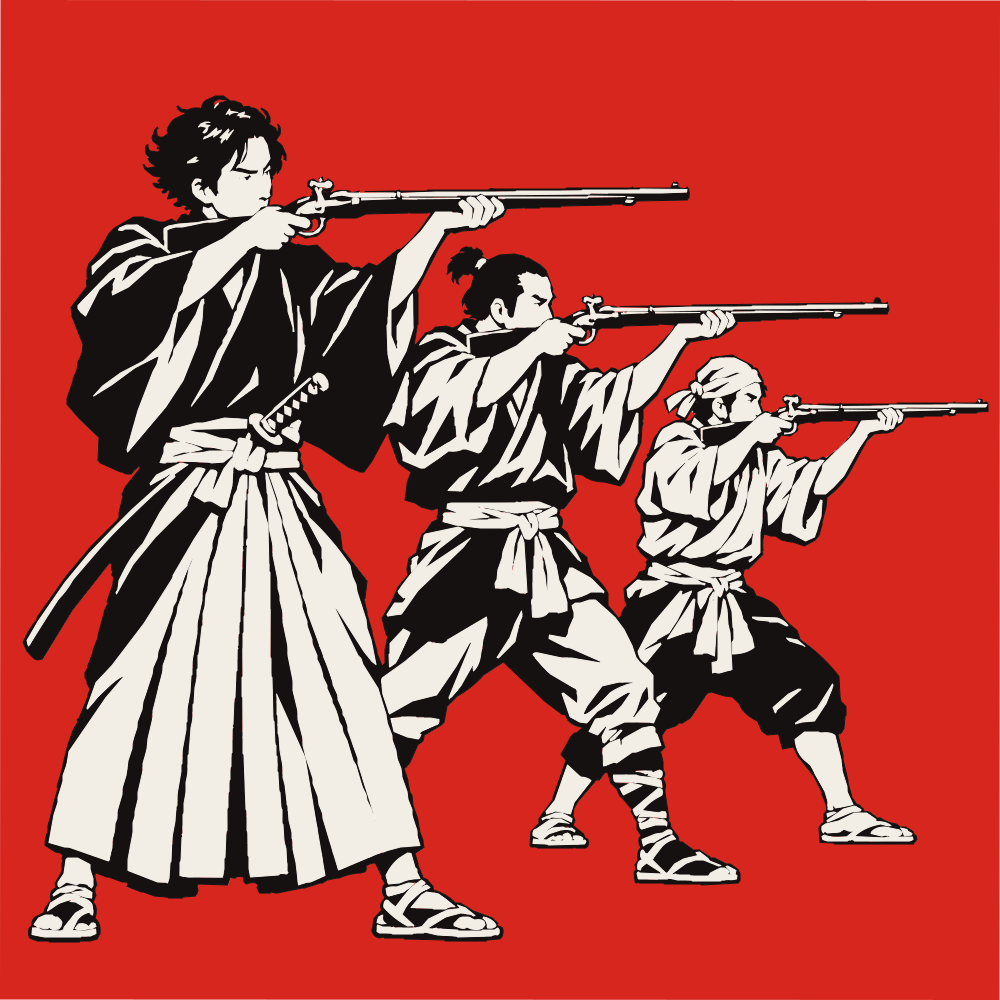
But Chōshū, equipped with new Western-style rifles and fighting mainly with units recruited regardless of rank, pushed back the shogunate forces on several fronts. Shinsaku commanded the navy on the Kokura front, crossing the Kanmon Strait to attack the territory of the Kokura domain on the opposite shore. In August the Kokura domain set fire to its own castle and withdrew.
A huge shogunate army had been unable to defeat a single domain. This result showed everyone how much the shogunate had weakened. By then Shinsaku was already being eaten away by illness.
1867
終
1867
1867
Dying at 27
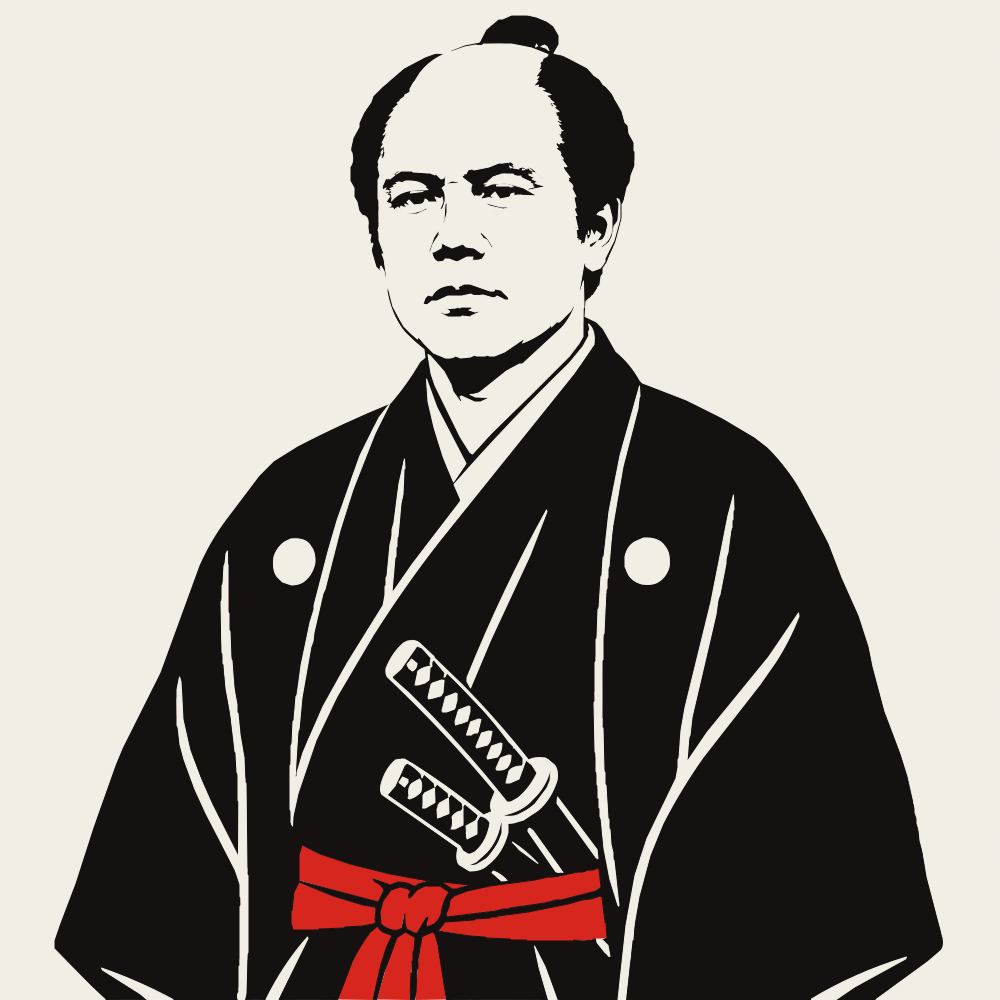
In 1867 Shinsaku died of illness at 27, before he could see the shogun return political power to the emperor (the Taisei Hōkan).
Death poemOmoshirokikoto mo naki yo oomoshirokuLower verse (said to be added by Nomura Motoni)Sumi nasu mono wakokoro nari keriWhat makes it so lies only in the heart.
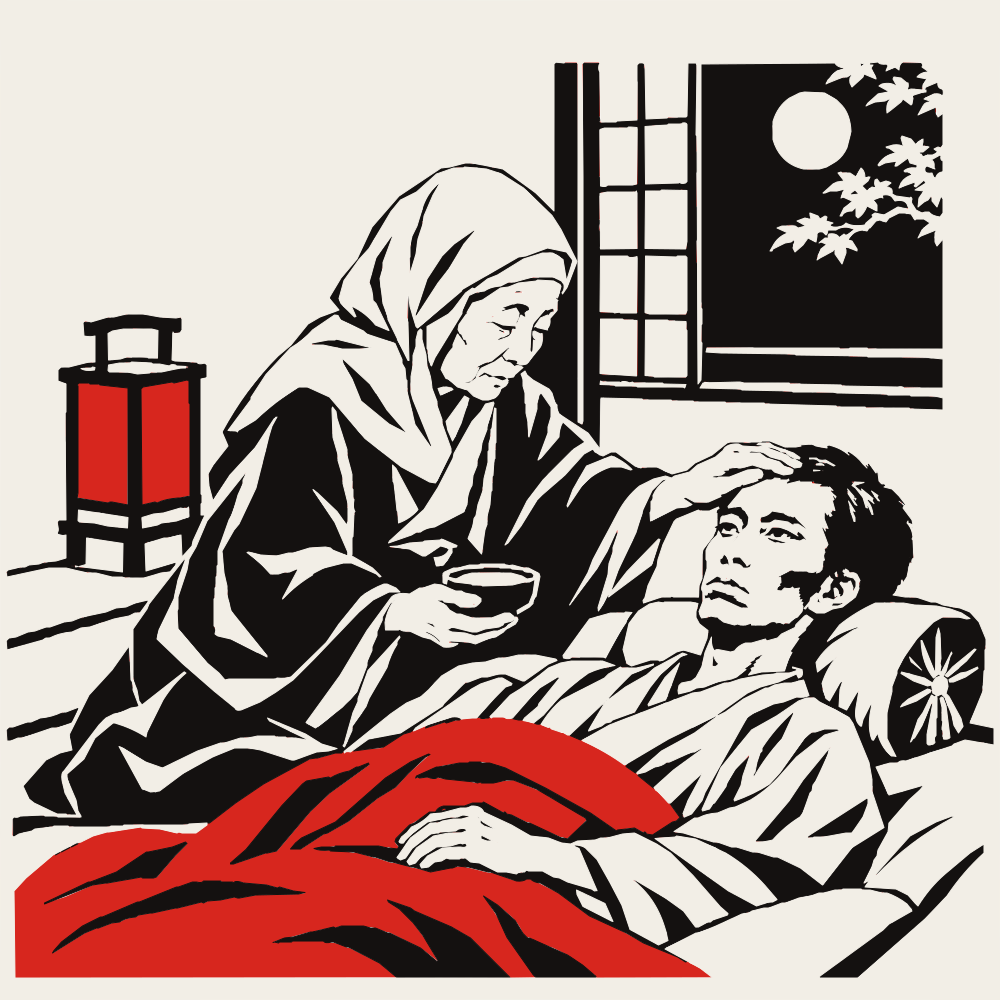
Shinsaku had tuberculosis. After the Four Borders War his illness worsened, and he died in Shimonoseki on the 14th day of the 4th month of 1867 (old calendar; May 17 in the modern calendar). He was 27 years old.
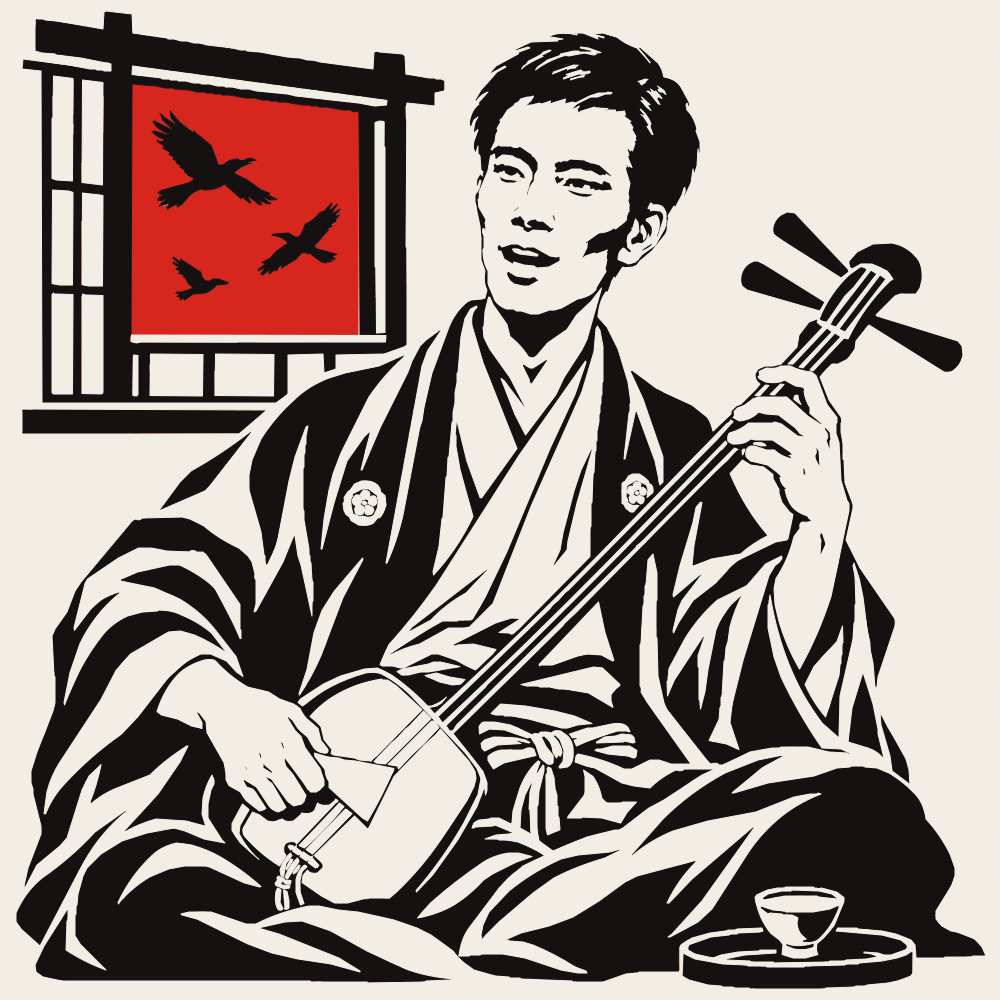
"Kill all the crows of the three thousand worlds, and sleep late with you." A famous dodoitsu (popular song) attributed to Shinsaku by tradition; its authorship is debated, so it is presented as tradition.
The death poem attributed to him begins "Omoshiroki / koto mo naki yo o / omoshiroku" (some say this first part was composed the year before). It can be read as something like "A world with nothing fun in it: let me make it fun." It sounds very much like Shinsaku. The rest of the poem is said to have been added by Nomura Motoni, the woman who nursed him.
About six months after his death, in the 10th month of 1867 (old calendar), the shogun handed governing power back to the imperial court (the Taisei Hōkan), and the Edo shogunate moved toward its end. Shinsaku never saw that moment, but he was one of those who opened the road leading to it.
On this site, years follow the Western calendar and months follow the calendar used in Japan at the time (the lunisolar, or "old," calendar).
Timeline
Shinsaku died about six months before the Taisei Hōkan.
Event
Confinement
Flight and hiding
1839Takasugi ShinsakuTakasugi Shinsaku is born in Hagi
1853.06Events in JapanPerry's Black Ships arrive at Uraga
1858Events in JapanThe Ansei Purge begins (until 1859)
1858.06Events in JapanThe Treaty of Amity and Commerce between Japan and the United States is signed
1859Takasugi ShinsakuHis teacher Yoshida Shōin is executed
1860Events in JapanThe Sakuradamon Incident: Ii Naosuke, the shogun's chief minister, is assassinated
1862Takasugi ShinsakuTravels to Shanghai and is shaken by the state of Qing China
1863Takasugi ShinsakuFounds the Kiheitai in Shimonoseki
1863Events in JapanThe Anglo-Satsuma War: the Satsuma domain fights Britain
1864.01Takasugi ShinsakuFlight and hidingFails to talk Kijima Matabei out of marching on Kyoto; leaves the domain without permission (dappan) for Kyoto
1864.03Takasugi ShinsakuConfinementEnters Noyama Prison (until June 21, about three months)
1864.06Takasugi ShinsakuConfinementConfined in a zashikirō at home (until August)
1864.08Takasugi ShinsakuServes as envoy for peace with the Four-Nation Fleet
1864Takasugi ShinsakuFlight and hidingFlees to Fukuoka as conflict in the domain grows fierce; sheltered by Nomura Motoni at the Hirao villa
1864.12Takasugi ShinsakuRaises troops at Kōzanji with about 80 men
1865.04Takasugi ShinsakuFlight and hidingGoes into exile with Kusanagi Enseki in Sanuki as conflict in the domain runs high (returns to Shimonoseki in June)
1866.01Events in JapanThe Satsuma-Chōshū Alliance is formed
1866.06Takasugi ShinsakuThe Four Borders War: fights the shogunate forces at Kokura and elsewhere
1867.04Takasugi ShinsakuShinsaku dies of illness at 27
about half a year
1867.10Events in JapanThe Taisei Hōkan: the shogun returns governing power to the imperial court
Years follow the Western calendar; months follow the lunisolar calendar used in Japan at the time (the "old" calendar).
Places to visit
Places where you can still follow Shinsaku's footsteps. Each opens in Google Maps.
Hagi
1Birthplace of Takasugi Shinsaku
Shinsaku was born in 1839 at the Takasugi family residence that stood here, in the castle town of Hagi. A well said to have been used for his first bath and a monument with his poem remain.
The private academy taught by Yoshida Shōin, where Shinsaku studied. It is one of the components of the "Sites of Japan's Meiji Industrial Revolution".
A park above Shimonoseki's harbor and the Kanmon Strait with a statue of Shinsaku (said to be a ceramic one, erected in 1956, ninety years after his death).
A shrine that began as the Sakurayama memorial ground, set up in 1865 at Shinsaku's proposal to honour Kiheitai soldiers and others who died in battle. It is said to be the oldest of its kind in Japan.
On the site of the Meirinkan domain school, where Shinsaku also studied; the main building covers its history and Building 2 houses a Bakumatsu museum.
Opening hours
9:00–17:00(施設により異なる)。2月第1火曜とその翌日休館
Admission
本館無料、2号館 大人300円・高校生200円・小中学生100円
Opening hours and admission may change — please check the official website.Checked: 2026-11-16